
 Türkçe
 Deutsch
 Français

Rezum treatment is a minimally invasive prostate reduction method that opens urinary tract narrowing caused by benign prostatic hyperplasia (BPH) using the natural thermal energy of sterile water vapor without any surgical incision. It is based on the principle of injecting water vapor heated with radiofrequency energy into the enlarged prostate tissue to deactivate the cells causing the obstruction. This water vapor therapy, which provides an innovative alternative to prostate enlargement surgeries, is a tissue-friendly procedure developed especially for patients who want to avoid the risks associated with conventional surgery. By safely restoring urinary flow to normal, this technology enables patients to return to their daily lives quickly and comfortably.
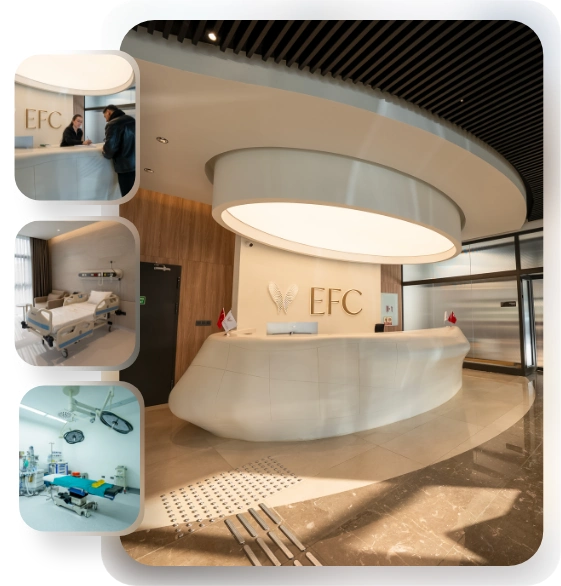
EFC Surgery Center
Comprehensive Care: From Initial Consultation to Follow-Up.
EFC Surgical Medical Center is a center of excellence specializing in the most meticulous fields of surgical medicine, from aesthetic surgery to interventional treatments—where every step progresses with refined attention. Medical excellence, aesthetic precision, and uncompromising ethical standards converge on the same path. Our subspecialty-trained experts aim to achieve natural and reliable results by delivering evidence-based care supported by modern imaging, standardized protocols, and safety systems. From consultation to recovery, your care is coordinated end-to-end with clear communication, transparent planning, and genuine respect for your health.
How Does Benign Prostatic Hyperplasia Make Patients’ Lives Difficult and Why Is Rezum Important at This Point?
The pressure exerted by the prostate gland on the urinary tract is not actually a condition that appears suddenly; it is an insidious process that develops gradually over the years. The bladder muscles, trying to push fluid through the narrowed urinary tract, initially begin to contract more strongly in order to adapt to this condition. Just as the muscles of a bodybuilder become thicker, the muscles of the urinary bladder also thicken, harden, and gradually begin to lose their natural flexibility over time. A bladder with reduced flexibility becomes unable to wait until it reaches its normal capacity before needing to empty. Even when only a very small amount of urine accumulates, it gives the person an urgent feeling of needing to go to the toilet.
This condition gradually takes over patients’ social lives and psychological well-being. Having to get up to use the toilet repeatedly during the deepest part of sleep at night makes quality sleep impossible. A body that cannot rest sufficiently experiences constant daytime fatigue, concentration problems, and irritability. In social life, the situation becomes even more restrictive. Taking long bus journeys, watching a movie in the cinema, or being stuck in traffic becomes a major source of stress for patients. Many people subconsciously keep calculating where the nearest toilet is whenever they go outside. The main symptoms patients encounter in daily life are as follows:
- Frequent urination
- Waking from sleep at night
- Weak urinary stream
- Interrupted urination
- Feeling of incomplete emptying
- Sudden urgency attacks
- Dribbling
Water vapor technology was developed precisely to put a stop to this decline in quality of life. When applied in the early stages of the disease, it aims to eliminate the obstruction in the urinary tract before the bladder muscles become irreversibly damaged. In this way, the bladder is relieved from overworking, and the person gains the opportunity to return to their former comfortable days.
Why Is Rezum Treatment Being Discussed More Frequently Today Instead of Prostate Medications and Traditional Surgeries?
When patients are diagnosed with prostate enlargement, the first treatment usually started is medication. These medications essentially aim to ease urinary flow by relaxing the muscles around the urinary channel or to gradually reduce the volume of the prostate gland. However, these medications are products that need to be used for life and serve to relieve symptoms rather than eliminate the disease. Moreover, many of these medications can lower blood pressure and cause dizziness, blacking out when standing up suddenly, constant fatigue, or reduced sexual desire. After a while, many patients become tired of the obligation to take medication every day and the burden these side effects place on daily life.
When medications become insufficient, surgical methods come into play. Surgeries that have been performed for years and are based on scraping the prostate from the inside or removing it completely with a laser are highly effective in opening the urinary tract. However, because the prostate tissue is mechanically cut or removed as part of the nature of these operations, bleeding may occur during the procedure. This situation creates a risk especially for elderly heart patients who have to use blood thinners. In addition, these major operations require general anesthesia or deep anesthesia in which the lower half of the body is numbed, and patients are required to stay in the hospital for several days.
Water vapor therapy is an option that bridges these two extremes. It neither requires patients to tolerate the side effects of lifelong medication use nor carries the burdens of major surgery, such as bleeding, anesthesia, and hospital stay. The fact that the procedure reduces the prostate from the inside using only the energy of natural water vapor without cutting any tissue makes this method a far less exhausting alternative for patients.
How Does the Water Vapor Energy Behind Rezum Treatment Work in the Body?
The use of water vapor as a treatment tool in medicine is based on one of the fundamental laws of physics, namely phase-change energy. When water is boiled and transformed from a liquid state into a gaseous state, a tremendous amount of energy becomes trapped in the vapor. This is called latent heat. The sterile water vapor produced by the system is delivered directly into the exact center of the enlarged prostate tissue that is causing the obstruction through a special device.
The vapor spreads very rapidly through the microscopic spaces between the cells inside the prostate. As the vapor moves through the tissue, it cools the moment it comes into contact with the cells and turns back into liquid water droplets. While returning from the gaseous state to the liquid state, it releases the enormous thermal energy trapped within it into the surrounding tissue in about one tenth of a second. This sudden and high-energy release disrupts the membranes of the excess prostate cells causing the obstruction and stops the flow in the fine capillaries supplying that area. As a result, the tissue in that region loses its vitality.
From this point onward, the body’s own natural healing mechanism comes into action. The immune system detects the prostate tissue in that area that has lost its vitality, just as it gradually heals a bruise under the skin. Special cleansing cells are sent to the area, and these cells slowly break down the dead tissue over a period of weeks and remove it from the body. As this cleansing process continues, the urinary channel gradually begins to widen on its own even though no piece has been cut out or removed externally. In addition, the vapor moves only within a clearly defined area; it cannot pass through the healthy capsule surrounding the prostate. In this way, the surrounding tissues are safely protected from thermal energy.
Contact us now to get detailed information about our treatments and procedures and to schedule an appointment!
Which Patients with Prostate Enlargement Are Generally More Suitable Candidates for Rezum Treatment?
The success of this treatment depends on matching the right method with the right patient anatomy. Not every treatment may be suitable for every patient, so a detailed urological evaluation is essential. This method generally works very efficiently in prostate tissues whose volume remains within certain limits and has not reached excessively massive dimensions. In addition, some prostates do not only enlarge sideways but also develop a structure that protrudes inward toward the bladder, that is, the urinary bladder. Thanks to the flexible application angle of the method, tissue showing such different growth patterns can also be treated.
This treatment stands out especially for individuals who are young or older but still lead socially active lives. It offers a practical solution for those who do not want their daily activities, business trips, or social lives to be interrupted by hospital processes. Patient groups who generally have a suitable profile for water vapor therapy include:
- Those who are bothered by medication side effects
- Those who want to preserve their sexual functions
- Elderly individuals considered at risk for anesthesia
- Those receiving blood-thinning treatment
- Those who want to avoid long hospital stays
- Those who have to use a permanent catheter
These patient groups consist of people who may not be able to tolerate the additional physical burden of major surgical interventions or who do not want to take that risk. The tissue-friendly nature of the procedure opens a safe pathway for relieving urinary obstruction, especially for patients considered high risk for standard surgery because of advanced age or heart problems.
In Which Special Health Conditions Is Rezum Generally Not Preferred?
Although it applies to a very wide range of patients, certain special anatomical or systemic conditions may prevent the application of water vapor therapy. Before the procedure, doctors carefully evaluate the patient’s medical history, previous operations, and other existing conditions. The most important rule is that the area where the procedure will be performed must be completely healthy and free of infection. If the patient has an active and untreated urinary tract infection, this condition is first treated with antibiotics and the procedure is postponed.
The second important criterion is the absence of suspected cancer. Although prostate enlargement is usually a benign process, if even the slightest suspicion is seen in blood tests or physical examination, the condition must first be clarified with a biopsy before treatment. Water vapor therapy is not designed to destroy cancer cells; its purpose is only to open the physical obstruction created by benign enlargement. In addition, patients with different structural problems in the bladder or urinary tract anatomy should be examined in detail. Medical conditions in which the procedure is generally not considered appropriate include:
- Active urinary tract infections
- Suspicious cancer findings
- Presence of a rigid penile prosthesis
- Artificial urinary continence devices
- Advanced urethral strictures
- Neurogenic bladder disorders
For patients who have one of the conditions on this list, planning a different, personalized surgical or medical approach that resolves the problem at its root or does not damage existing implants is a much more appropriate course of action.
What Should Patients Expect on the Day of Surgery and How Is the Rezum Procedure Performed Step by Step?
For patients, the word surgery usually evokes stressful days, intensive care units, and painful awakenings. However, water vapor therapy has a flow that can be performed on an outpatient basis and places very little psychological burden on the patient. On the day of the procedure, the individual who comes to the hospital goes through a short preparation process in their room. Depending on the patient’s general health condition and the doctor’s preference, local anesthesia may be applied by injecting only an anesthetic gel into the urinary tract, or mild relaxing medications may be administered intravenously so that the patient does not become anxious. Most of the time, the patient does not need to fall into a deep sleep.
The procedure begins by gently advancing a very thin special instrument with a high-resolution camera at its tip through the urinary tract. On a monitor, the doctor sees the inside of the urinary channel, the prostate tissue, the bladder entrance, and the extent of the obstruction clearly and in real time. Once the prostate tissue blocking the urinary tract is identified, a very thin needle is advanced from the tip of the instrument into the tissue. When the system’s button is pressed, a preset dose of hot water vapor is released into the center of the tissue for exactly 9 seconds. Depending on the size of the prostate, this process is repeated several times on the right and left sides.
To prevent the vapor from damaging the outer urinary tract or the bladder, the temperature balance is maintained throughout the procedure by continuously rinsing cool saline through the device. Completing the vapor injections required for an average-sized prostate takes only about 10 to 20 minutes. Since no tissue is cut, no bleeding surface is left, and no sutures are placed, the procedure ends on the treatment table. After resting for a few hours, the patient can generally walk home on the same day.
Contact us now to get detailed information about our treatments and procedures and to schedule an appointment!
How Does the Recovery Process Progress After Rezum and What Temporary Conditions May Occur?
The fact that everything is completed quickly on the treatment table does not mean that urinary flow will improve immediately at that moment. The thermal effect of the water within the tissue causes temporary edema, in other words swelling, in the prostate tissue during the first days, much like the swelling of a sprained ankle. Because this swelling can completely block an already narrowed urinary tract, a temporary urinary catheter is inserted immediately after the procedure. The patient is sent home with this catheter.
The catheter generally remains in place for only a few days; as the swelling begins to subside, it is removed painlessly under the doctor’s supervision. After the catheter is removed, patients begin to urinate on their own, but the healing process progresses in parallel with the gradual clearing of the tissue. The real increase in urinary flow and relief usually begins to be felt after the second week. As the body breaks down and eliminates the tissue that has lost its vitality through the urinary tract in fragments, the channel gradually opens. The most satisfying results are achieved over a period of months, once tissue absorption is fully established. During this process, it is natural to experience some temporary urinary complaints depending on tissue healing. Conditions that may occur during the recovery phase include:
- Mild bleeding
- Burning during urination
- Frequent need to use the toilet
- Temporary urinary urgency
- Change in semen color
None of these symptoms indicates a complication or an error; on the contrary, they are natural reflections of the body’s healing effort. With simple painkillers or bladder-relaxing medications, this transition period can be managed quite comfortably and disappears completely over time.
How Can Sexual Functions, the Biggest Concern for Men, Be Preserved with Rezum?
When prostate surgery is mentioned, the greatest and most understandable fear that comes to men’s minds is the concern that their sexual lives may be harmed. In traditional scraping or removal procedures, the center of the prostate is completely hollowed out. During this hollowing process, the muscular structure at the bladder outlet loses its integrity, and the openings of the small ducts that carry semen into the urinary tract are shaved away together with the tissue. As a result, when patients have sexual intercourse after surgery, semen cannot exit outward; it flows backward through the open bladder neck into the urinary bladder and is later expelled together with urine. This condition, known as dry ejaculation, is irreversible and is the main reason many men avoid surgery.
The greatest difference of water vapor therapy is that it respects the anatomy. Vapor is injected only into the enlarged side lobes of the prostate. The bladder neck and the structure of the ducts through which semen travels largely remain in their original form. Since the anatomical gateways are not disrupted, the risk of retrograde ejaculation is very low. In fact, patients who previously experienced dryness due to medication use may return to their former pattern after the procedure because they stop taking the medications.
Another important issue is erectile function. The delicate nerve networks that go to the penis and enable erection pass directly over the outer capsule of the prostate. Because the energy used during the procedure is convective, it does not cross the outer capsule of the prostate and spread into the surrounding tissues. Since the nerves are not exposed to thermal damage, the risk of developing erectile problems afterward is considerably reduced. With these characteristics, the method offers a highly balanced solution for men who do not want to compromise their sexual lives.
According to Clinical Results and Patient Follow-Ups, What Is the Long-Term Success of Rezum Treatment?
The success of a medical method is measured not only by the relief achieved in the first weeks but also by the value it adds to the patient’s quality of life years later. Scientific data and long-term follow-ups show that the effects of water vapor therapy on urinary obstruction are quite lasting. The values of patients who constantly get up to use the toilet at night, urinate drop by drop, and cannot fully empty their bladder before treatment approach the standards of a healthy man within months.
Doctors monitor this improvement with objective data. Tests measuring urinary flow rate show a significant increase months after the procedure. The amount of residual urine left in the bladder after urination, which creates a favorable environment for infections, decreases substantially. From an anatomical perspective, a visible reduction and shrinkage in the total volume of the prostate is detected in the months following the procedure. The bladder, relieved from constant pressure, gradually regains its former flexibility and adapts to functioning at normal capacity.
When four- or five-year follow-up results are examined in terms of the durability of the treatment, it is reported that the vast majority of patients who undergo the procedure continue their lives without needing an additional intervention or prostate medication. The proportion of patients who require treatment again years later remains very low. Today, the goal of modern medicine is to achieve the most appropriate physiological recovery without unnecessarily exhausting the body, disrupting anatomy, or interrupting the patient’s social life. Water vapor therapy continues to prove its value as a reliable, modern, and lasting solution in the fight against benign prostatic hyperplasia with the comfort it provides, the functions it preserves, and its long-term results. Patients who allow the necessary time for recovery and give their bodies the opportunity to repair themselves can ultimately enjoy the comfort of a medication-free and unrestricted life.
Blog Posts
Hair Transplant Prices
Hair transplant prices vary depending on the technique to be used, the number of grafts, [...]
Read More
21
Jan
Jan
Most Preferred Countries for Plastic Surgery
Among the most preferred countries for plastic surgery, Turkey, South Korea, the United States, and [...]
Read More
21
Jan
Jan
Plastic Surgery Prices
Plastic surgery prices vary depending on the type of procedure, geographical location, the surgeon’s experience, [...]
Read More
21
Jan
Jan
Physical Therapy Prices
Physical therapy prices vary depending on the number of sessions to be applied, the treatment [...]
Read More
21
Jan
Jan
Dental Treatment Prices
Dental treatment prices vary depending on the type of procedure to be performed, the quality [...]
Read More
21
Jan
Jan
Most Preferred Countries for Dental Treatments
Among the most preferred countries for dental treatments are Turkey, Hungary, Mexico, and Thailand. These [...]
Read More
21
Jan
Jan